

Iran says 20,000 people left without water after US hits reservoir tanks
Washington says its jets targeted air defence and radar sites after Iranian forces downed American helicopter


Iran said US air strikes had left 20,000 residents in its southern Hormozgan province without water after two storage reservoirs were destroyed in the latest exchange of fire between the two sides. The flare-up came after Iran shot down an American helicopter over the Strait of Hormuz. The US launched air strikes overnight on southern Iran in response. The US military’s Central Command said its fighter jets targeted Iranian air defence, ground control stations and surveillance radar sites near the Strait of Hormuz with “precision munitions”. It described the strikes as a “proportional response” to recent Iranian attacks on US forces and merchant vessels. But Iranian officials in Hormozgan said the US strikes early on Wednesday destroyed two storage reservoirs with a combined capacity of 2,500 cubic metres. The tanks supplied water to residents in the city of Kuhestak and 10 surrounding villages in the Bemani district. A US defence official said on Wednesday they were ‘‘aware of reports” of the strikes on the water storage plants.
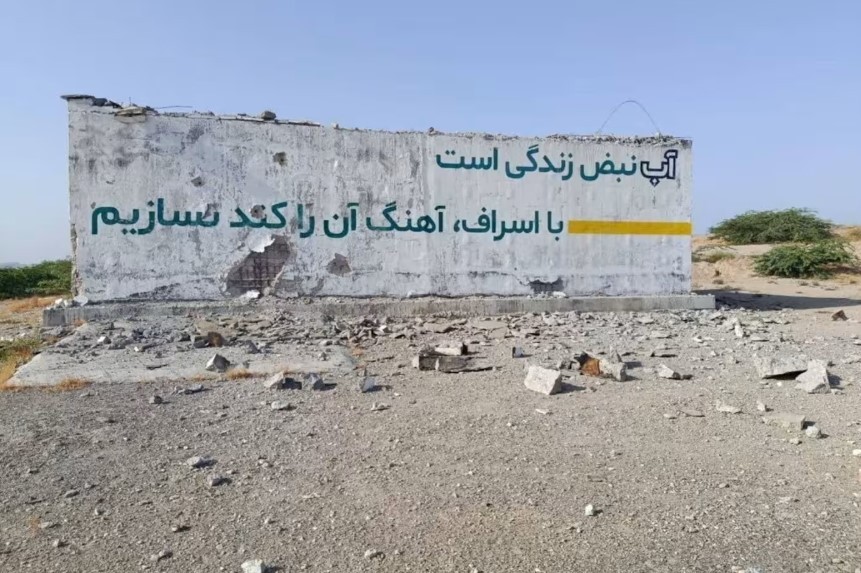
The clashes were the most serious between the US and Iran since the warring parties agreed to a fragile ceasefire on April 8. They also threatened to jeopardise diplomatic efforts to finalise a deal between Washington and Tehran to extend the ceasefire, reopen the Strait of Hormuz and lay the framework for negotiations on Iran’s nuclear programme. Over the course of the 40-day war, the US and Israel carried out strikes that damaged several civilian facilities, including the B1 Bridge in Karaj, the Pasteur Institute — a leading medical research centre in Tehran — and several universities. Abdolhamid Hamzepour, director of the Hormozgan Water and Wastewater Company, told local media that “over 20,000 local residents, who live under the harshest climatic conditions and extreme heat, have lost access to safe drinking water” as a result of the attack.
Iran’s Revolutionary Guards said its forces responded to the American strikes by targeting the US Navy’s Fifth Fleet in Bahrain and firing missiles at a US air base in Jordan. The exchange of fire appeared to be contained on Wednesday with no reports of renewed strikes. Esmaeil Baghaei, Iran’s foreign ministry spokesperson, said the US was harming the diplomatic process through its “contradictory messaging and repeated ceasefire violations”, adding that Israel was also undermining the process through frequent ceasefire breaches in Lebanon. He added that the Iranian military would “not hesitate in defending” the country. Local authorities in Hormozgan said they were carrying out emergency measures, including deploying tanker trucks and temporary pumping systems, to deliver water to the affected residents.
Temperatures in the region at present range between 45C and 50C, putting the local population in extremely critical conditions. The company said the destruction of the reservoirs had created a big challenge for the local water supply network because groundwater reserves in the area were insufficient and could not provide an immediate replacement. The company estimated the damage to the region’s water infrastructure at IR1.4tn (roughly $800,000). It stated that rebuilding the reservoirs would be time-consuming, but said it would mobilise all its resources to quickly restore a stable water supply to the region. In March, Iran accused the US of striking a desalination plant on Qeshm Island, which it said disrupted water supply to 30 villages. The US denied carrying out the attack.
What's Your Reaction?
 Like
0
Like
0
 Dislike
0
Dislike
0
 Love
0
Love
0
 Funny
0
Funny
0
 Wow
0
Wow
0
 Sad
0
Sad
0
 Angry
0
Angry
0
Comments (0)